
On this page
Why Licensing Is Only Part of the Answer
A licensed electrician can legally install an EV charger in Jacksonville. But a license only proves they know general wiring. EV chargers have their own rules for circuit sizing, charger settings, and outdoor protection, so experience with these installs matters just as much.
Yes, any licensed electrician is allowed to install your EV charger. That's the legal answer. The practical answer is a little different.
A license shows someone passed the exams and follows the code. It doesn't show they've wired dozens of chargers. And EV chargers aren't like adding an outlet in your living room.
Your charger pulls power for hours at a time. Often all night. The National Electrical Code treats this as a continuous load, so the circuit has to be sized bigger than the charger's rating. A 48-amp charger needs a 60-amp breaker, not a 50.
We see this mistake more than you'd think.
One homeowner called us after their breaker kept tripping every night. The charger was set to its highest amp setting. The circuit behind it was too small for that. Nobody had matched the two, the fix took an afternoon. But they'd lost weeks of reliable charging first.
So what does EV experience look like? Here's what a seasoned installer checks that a general electrician might skip:
- A load calculation, which checks if your panel can handle the new circuit on top of your AC and water heater
- Breaker and wire size matched to the charger's real amp setting
- The charger's internal settings, like the amperage switch on a Tesla Wall Connector
- Outdoor-rated parts that hold up to Jacksonville rain and summer storms
- Charger placement that fits your garage or driveway and your HOA rules
Each one sounds small. Miss any of them and you can end up with nuisance trips, slow charging, or a failed inspection.
Local conditions matter here too. Florida's air is humid most of the year. Hurricane season brings sideways rain into carports and open garages. An outdoor charger needs a weather-rated enclosure and sealed connections. Placement should keep it clear of standing water too.
Then there's paperwork. A charger circuit needs a permit through the City of Jacksonville and an inspection after. Some electricians skip it to save time, that's a gamble you don't want. An unpermitted circuit can cause headaches when you sell your home or file an insurance claim.
Why does this matter so much? Because you'll use this circuit every single day for years.
Our owner, Vlad, holds Florida license ER13016446. We pull the permits and schedule the inspection for you. We also check your panel before we quote anything. If your JEA or FPL service needs attention first, you'll know up front. The price we quote is the price you pay.
So when you're hiring, don't stop at asking for a license. Ask how many chargers they've put in this year, and whether they'll do a load calculation before they start.
What Makes EV Charger Wiring Different From a Standard Outlet
An EV charger pulls far more power than anything else in your garage, and it pulls it for hours. That's the big difference. A regular wall outlet runs on 120 volts and is built for short bursts, like a phone charger or a shop vac. A Level 2 charger runs on 240 volts, the same kind of power your dryer or AC uses.
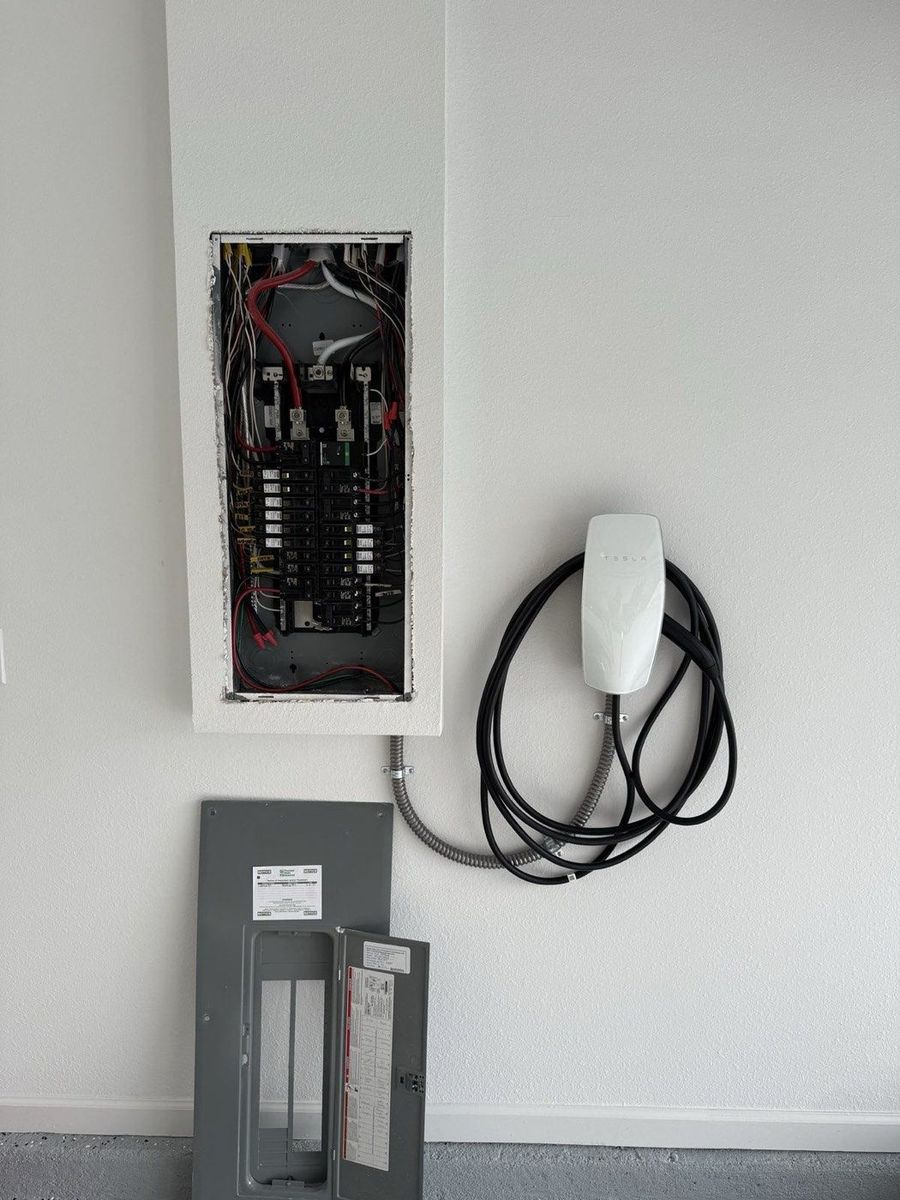
But it's not just about voltage. Your dryer runs for an hour, then shuts off. An EV can charge for six or eight hours straight, every single night.
So the wiring has to handle that steady load without getting hot.
The National Electrical Code calls this a continuous load. It says the circuit must be sized at 125% of what the charger draws. A charger that pulls 48 amps needs a 60-amp breaker and wire that can carry it. Get that math wrong and the breaker trips all night, or worse, the wire heats up inside your wall.
Here's what sets an EV charger circuit apart from a standard outlet:
- Its own dedicated circuit, shared with nothing else in the house
- A double-pole 240-volt breaker, often 40 to 60 amps
- Thicker wire, usually 6-gauge copper for a 60-amp run
- GFCI protection when the charger plugs into an outlet instead of being hardwired
- A load calculation, which checks if your panel can handle the new circuit
That last one trips up a lot of folks. Plenty of Jacksonville homes, especially older ones, still have 100-amp panels. Add a 60-amp charger to a house already running AC, a water heater and an electric range, and you can run out of room fast. We check this on every job before we quote anything. Sometimes the panel's fine. Sometimes we need a smaller charger setting or a load-management option instead.
Think about a quick scenario. A homeowner buys a new EV and grabs a 240-volt outlet adapter online. A handyman adds a plug on an old 30-amp dryer circuit. The car charges, mostly, but the outlet starts to brown and smell warm after a few weeks. We see this mistake more than you'd think, the fix almost always means redoing the circuit from scratch.
Where you put the charger matters too. Is it going in the garage, or out by the driveway? An outdoor charger here has to stand up to summer heat, heavy afternoon storms and hurricane season. That means weather-rated boxes, sealed connections and conduit that keeps water out. And if you live in a community with an HOA, there may be rules about what's visible from the street.
None of this is rocket science for a licensed electrician who does it often. But it's a long way from swapping an outlet. The sizing, the panel check and the permit all have to line up, or the inspector won't sign off.
Our owner Vlad holds license ER13016446, and we pull the permit and handle the inspection for you. You get a clean install, a swept-up garage and a price that doesn't change once we've quoted it.
Outdoor Installation Considerations for Florida Homes
Yes, a licensed electrician can put your EV charger outside. But an outdoor EV charger installation in Jacksonville takes more planning than a garage job. Our weather is hard on electrical gear, and the install has to be built for it.
Lots of homes here don't have a garage spot that works. Maybe the garage is full of storage. Maybe you park in the driveway every night. Either way, the charger ends up on an outside wall or a post, out in the heat and rain.
So what does a good outdoor job look like?
Before we mount anything, we walk the spot with you. Here's what we check on every outdoor EV charger installation:
- The weather rating on the charger. You want a unit made for outdoor use, often marked NEMA 3R or NEMA 4.
- GFCI protection, a safety device that cuts power fast if current leaks where it shouldn't.
- Sealed conduit and fittings so rain can't run down the pipe and into the box.
- Mounting height, set high enough to clear standing water and meet code.
- Cord reach to your car's charge port without stretching across a walkway.
None of these are fancy upgrades. They're the basics that keep an outdoor charger safe for years.
Salt air is a big one near the coast. Homes in Atlantic Beach, Neptune Beach, and Jacksonville Beach see faster corrosion on screws, boxes, and connectors. We pick hardware that holds up better to salt, and we place the charger where it gets some cover when we can. A spot under an eave or on the side away from the ocean wind helps a lot.
Then there's hurricane season. Wind-driven rain can push water sideways into gear that stays dry in a normal storm. We've opened up outdoor boxes after a summer storm and found water sitting inside, the fittings were never sealed right. That's a mistake we see all the time on rushed installs.
Here's a real example. A homeowner on the Southside called us after their charger kept tripping every time it rained. The unit was fine. The problem was an indoor-rated box someone used for the outdoor connection. We swapped it for a weatherproof setup and resealed the conduit. No more trips.
Heat matters too. A charger on a west-facing wall can bake in the afternoon sun. Some units slow down charging when they get too hot. And the wire size has to account for heat, since hot wire carries less current safely.
Low spots are worth a look as well. If your driveway floods during heavy rain, we mount higher and keep connections up off the ground.
Don't forget your HOA. Many neighborhoods around Jacksonville have rules about what can go on the front of a house. Some want the charger on the side wall or out of street view. It's smart to check before install day, it saves you from moving it later.
We also handle the permit and inspection for you. The city inspector checks the outdoor work, so you know it was done to code. Whether your power comes from JEA or FPL, the permit process is part of what we take care of.
Outdoor charging works great in Florida when it's planned for Florida.
Frequently Asked Questions
Can a normal electrician install a car charger?
Yes, any licensed electrician can legally install a car charger. A license proves someone passed wiring exams and knows the code. It doesn't prove they've handled dozens of EV charger installs. These jobs need a load calculation, matched breaker sizing, and correct charger settings. Ask how many chargers an electrician has installed this year before you decide.
Do I need a city permit to install an EV charger?
Yes, a charger circuit needs a permit through the City of Jacksonville, plus an inspection afterward. Some electricians skip this step to save time, but that's a risky shortcut. An unpermitted circuit can create problems later when you sell your home or file an insurance claim. A good installer pulls the permit and schedules the inspection as part of the job.
Do electricians have to be licensed in Florida?
Yes, electricians working in Florida must hold a state license to perform wiring work legally. Licensing confirms someone passed exams and follows the National Electrical Code. It doesn't guarantee EV charger experience, since these installs involve continuous loads and sizing rules that differ from standard outlets. Look for a license number plus a track record of EV-specific installs.
Why does my EV charger need a bigger breaker than the charger's rating?
Your charger needs a bigger breaker because it runs for hours at a time, often all night. The National Electrical Code treats this as a continuous load, so the circuit must be sized at 125% of the charger's draw. A 48-amp charger needs a 60-amp breaker, not a 50-amp one. Getting this wrong causes nuisance trips or overheating wire inside your wall.
How does Jacksonville's weather affect an outdoor EV charger installation?
Jacksonville's humidity and storm season mean an outdoor charger needs weather-rated parts. Sideways rain during hurricane season can reach carports and open garages, so sealed connections and proper enclosures matter. Placement should also avoid spots where water collects during heavy downpours. These local conditions are part of why experience with outdoor EV installs counts as much as licensing.
Can my home's electrical panel handle an EV charger?
It depends on your panel's size and what else draws power in your home. Many older Jacksonville homes still have 100-amp panels, and adding a 60-amp charger alongside AC, a water heater, and a range can push past that limit. A load calculation checks this before any wiring starts. This step is covered in detail on our EV charger installation page, which explains what a proper panel check involves.
Related
Keep reading: EV charger installation in Jacksonville, Is your home ready for an EV charger?, How long EV charger installation takes. Or browse all of our electrical guides for Jacksonville homeowners.